
Who Is Seth Anderson?
Seth Anderson began his entrepreneurial journey in 2012, selling garden hoses sourced from a local liquidated warehouse. Anderson proceeds to display heavily cropped screenshots of his earnings, claiming to have generated hundreds of thousands purely through Amazon sales. He provides minimal detail beyond these claims.

Beyond these claims, there’s scant information available about Seth. His YouTube channel remains minimal with only 13 subscribers, and his initial opt-in page lacks a proper domain. While this doesn’t necessarily indicate poor course quality, it suggests subpar marketing execution. Seth acknowledges this shortcoming within The $100 Startup, stating, “I’m a seller, but I’m new to course creating.”
What Is “The $100 Startup”?
With numerous dropshipping courses available, such as High Ticket Dropshipping Academy, what distinguishes The $100 Startup? This course, taught by Seth Anderson, focuses on generating income through Facebook dropshipping. It should not be confused with Chris Guillebeau’s popular “$100 Startup” book, which inspired Anderson’s course title.
The course aims to deliver comprehensive Amazon FBA knowledge for generating rapid profits. Anderson promises thorough instruction covering product research, sourcing, and Amazon selling strategies.
How Much Is The $100 Startup?
The course costs $397 with no payment plans, discounts, or promotions available. It includes a “no questions asked” 60-day money-back guarantee, though this promise lacks legal backing in the terms and conditions. The package includes several bonuses:
- Access to Anderson’s private Facebook group for student communication
- Anderson’s “personal” curated product list
- One-hour Skype session with Anderson, which he claims typically costs “$300 per hour”

Seth Anderson’s Core Curriculum
The course consists of six modules, each representing a step in building your Amazon business. The modules are relatively brief, with the entire course totaling approximately 8 hours of content.

Module 1- How To Properly Get Set Up On Amazon
This introductory module begins with Anderson sharing his background before diving into Amazon fundamentals. He provides general business advice and success tips for the course, though the guidance follows familiar “take action, don’t just learn” principles without breaking new ground.
Anderson then covers Amazon account creation, often providing excessive detail for a relatively straightforward process. He introduces Amazon’s Seller Education hub—an online resource for learning advanced features—and encourages exploration of this platform.
Module 2- Product Selection
Module 2 builds momentum by covering product selection fundamentals. Anderson explores strategic product categories, best seller rankings, profit margins, and research methodologies. He demonstrates tools like DS Quickview and Unicorn Smasher, creating a solid foundation for Amazon newcomers.

Anderson offers valuable advice about avoiding oversaturated products, demonstrating current awareness of market trends and competitive dynamics.
Module 3- Product Sourcing
This module focuses on product procurement from various suppliers including Alibaba and AliExpress. Anderson provides practical advice about industry terminology and communication strategies essential for effective supplier relationships. He covers price comparison, negotiation tactics, shipping logistics, and FBA integration.
This proves to be one of the more valuable modules. Manufacturer communication involves complex processes, and Anderson delivers practical guidance that significantly simplifies these interactions.
Module 4- Product Listing
Product listing can be as complex as procurement itself. Listings dramatically impact sales performance—the keywords and images you choose can make or break conversions, making thorough research essential.
Anderson deconstructs product listings, covering keyword research, title optimization, descriptions, imagery, pricing strategy, and backend optimization. He explains how coordinating these elements can drive explosive growth.
One standout feature is Anderson’s approach to listing evolution. Sales and reviews significantly influence listing performance, so building momentum while maintaining profitability requires strategic pricing evolution over time.
For instance, if a product costs $12 to sell, Anderson suggests initial pricing at $13. While $1 profit seems minimal, this strategy generates substantial initial sales that boost product rankings. Over time, as sales accumulate, you can gradually increase prices until reaching a $20 product listing on Amazon’s first page.
Module 5- Product Launch
After completing research, planning, and ordering, the challenging phase begins. Moving your product from page 20 to page 1 represents a daunting task where many fail. While a strong product launch won’t guarantee top rankings, it can establish profitability.
Anderson covers launch strategies including customer review requests, social media utilization, coupon deployment, and product inserts. While some tactics are straightforward, they may not be obvious to new FBA sellers.

Beyond these basics, the module offers limited additional insights. However, beginners may find value in strategies that experienced marketers can easily locate through online research.
Module 6- Grow Your Business
This bonus module provides general “next steps” guidance, exploring topics like product refinement, new product introduction, branding development, marketing expansion, team building, and Facebook advertising implementation.
While offering solid surface-level direction, the section lacks depth but provides sufficient information to guide your next learning priorities.
Seth Anderson’s Course Quality
Course quality falls short of expectations. Most content uses PowerPoint presentations, which feels underwhelming for a $400 investment. Though Seth acknowledges being “new to course creating,” this doesn’t remedy the lackluster presentation quality.

Anderson supplements PowerPoints with screen recordings demonstrating Amazon and Alibaba navigation. These recordings meet standard expectations with clear audio quality and no technical interruptions. While audio and visual elements perform adequately, presentations represent Anderson’s weakest skill.
Does The $100 Startup Deliver?
Overall, the course fulfills its promise of providing comprehensive Amazon FBA understanding alongside supplier sourcing knowledge. Anderson effectively balances technical walkthroughs with foundational principles, creating clear student comprehension.
Anderson excels at teaching business preparation fundamentals. He invests considerable time explaining product research, pricing strategies, and competitive analysis, ensuring students enter dropshipping with optimal product selection.

However, his promises of “quick profits” and “$1,000 per month” earnings are demonstrably false. While students might achieve success using his general advice, the harsh reality is that Seth’s course won’t guarantee $1,000 monthly income. Students may generate some revenue, but earning potential depends entirely on individual execution. Despite Anderson’s constant advertising of these figures, his disclaimer states:
“There is no guarantee that you will make any income at all and you accept the risk that the earnings and income statements differ by individual” – Seth Anderson
Who Is Anderson’s Course Best For?
This course best serves absolute beginners who will discover significant value in the foundational content. However, those seeking advanced strategies or existing storefront optimization will find the course lacking. It doesn’t provide the sophisticated tactics needed for competitive advantage.
While unsuitable for advanced learners, it offers an excellent starting point for newcomers. Anderson delivers practical, actionable advice that proves valuable for those beginning their journey. For beginners, The $100 Startup represents a viable option.
Is The $100 Startup Worth The Money?
The critical question remains: is it worth $400? The answer depends on your current FBA knowledge level.
If you possess basic understanding of FBA concepts, this course may not justify the investment. While Anderson explains foundational principles effectively, his course contains nothing unique. The knowledge he teaches appears in virtually every “Amazon FBA” course available.
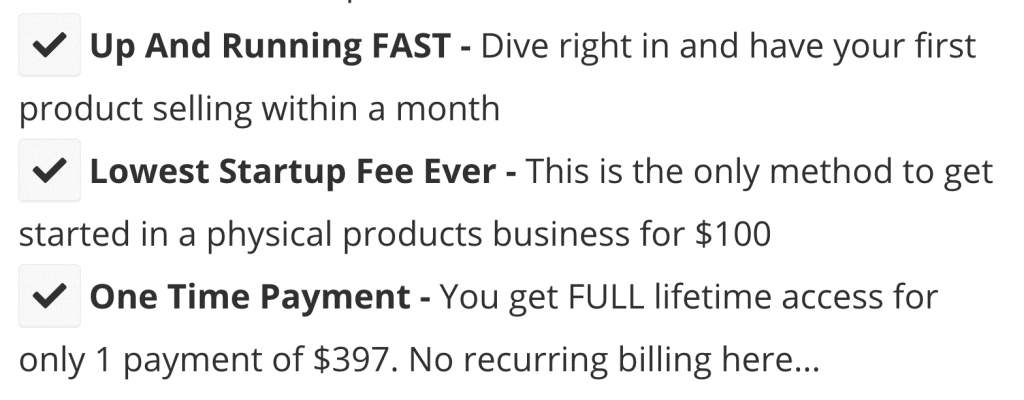
Anderson teaches effectively, but the course value doesn’t justify his pricing. For a fraction of this cost, you can access courses teaching identical principles.
$100 Startup Alternatives
Amazon FBA’s popularity ensures numerous alternative options. Here are several recommendations:
- Amazon Seller University– If you’re primarily interested in technical learning, consider Amazon Seller University. This free hub, created by Amazon, teaches platform usage and order fulfillment. While it lacks Anderson’s keyword and product research components, it covers fulfillment aspects comprehensively.
- Amazon Product Research (Sumner Hobart)– For product research expertise, consider Sumner Hobart’s specialized course. This program delivers 8 hours focused exclusively on in-depth product research. Best of all, it’s hosted on Skillshare, which offers a 2-month free trial.

- The Last Amazon FBA Course (Brock Johnson)– For complete FBA newcomers, consider this comprehensive option. Titled the “last” FBA course for good reason, it contains 54 hours of content covering every FBA aspect—from launching and sourcing to shipping, listing, and negotiation. Johnson creates an extensively detailed course that costs less than Anderson’s offering.
Our Final Verdict For The $100 Startup
Anderson successfully trains new FBA entrepreneurs through store setup and launch processes. However, he provides few unique or advanced strategies to justify his premium pricing. If this course appeared on Udemy for $10, it would represent excellent value. But charging $400 for this content is excessive, especially considering the limited production quality and superior alternatives available. Beginners would benefit more from saving money and exploring alternative courses.


